Black Kids Read the Diary of Anne Frank
Erin Gruwell took a chore educatee educational activity at Woodrow Wilson High Schoolhouse in Long Beach, California in 1994. Over the next 4 years, she found she changed not only her own life but likewise those of the 150 students that passed through her classroom. A recently completed documentary digs into her story, which was the basis for the 2007 film, "Liberty Writers" starring Hilary Swank as Gruwell.
The documentary explores Gruwell's feel working in a school that remained markedly segregated even decades subsequently the landmark Supreme Court decision Brown 5. Board of Education alleged "separate merely equal" unconstitutional. When Gruwell discovered students passing around a racist caricature of one of their classmates, she explained how this kind of imagery was comparable to the propaganda spread by the Nazis. When merely ane of the students had heard of the Holocaust, Gruwell decided to shift the focus of the course entirely.
Her unconventional instruction style moved away from the standard curriculum institute in most high school English classes – Shakespeare, the classics – and helped students to understand how narrative storytelling could be more than personal. She had her students keep journals, which allowed them to explore their ain personal experiences while also becoming empathetic to the experiences of others. Gruwell assigned readings from "The Diary of Anne Frank" and "Zlata'south Diary." She invited speakers to class, including Miep Gies, the Dutch woman who hid Anne Frank from the Nazis.
The new syllabus transformed the students. Not but did they embrace their ain work, taking pride in telling their own stories, they as well began to engage with students different from them. Where Gruwell first found intractable divisions betwixt students from different backgrounds, she suddenly began to see a growing agreement and even friendship.
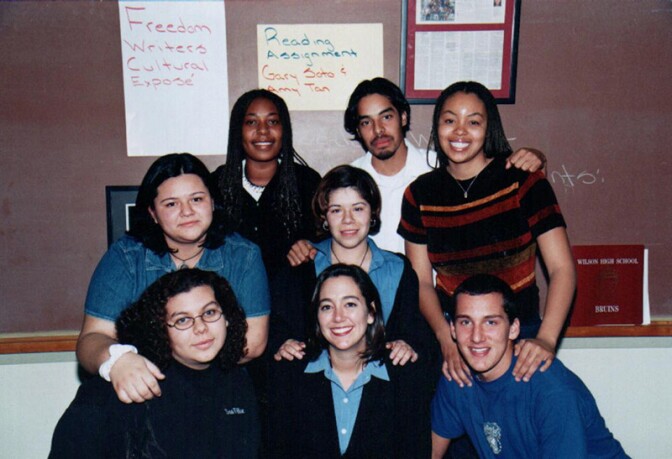
The students' work was compiled in "The Freedom Writers Diary", start published in 1999. The name paid homage to 1960s civil rights group, The Freedom Riders. The volume was a New York Times bestseller and has been published in over a dozen languages. Gain from sales of the book funded college scholarships for many of the original Freedom Writers.
The documentary release coincides with the book's 20th anniversary. Gruwell is currently working with students to compile a whole new set of stories for a new generation of young writers.
Q: How did this documentary develop?
Erin Gruwell: Andy Russell [President of Public Media Grouping of Southern California] came to ane of our local screenings and was so enamored with non but the motion-picture show but the event that nighttime. We packed this auditorium at UC Irvine with every cross-section of Fifty.A. from undocumented kids and high school students to college students, business organization leaders and Holocaust survivors — a dramatically diverse grouping, where we cried, and got downwards and dirty with these very intense subject matters about racism and inequality.
And so Andy and his team, expressed that they really wanted to make a documentary with u.s.. Nosotros are now doing seven different screenings across the six counties that PBS reaches, recreating the magic that Andy experienced that night.
Going back to 1994 when you showtime began teaching, what brought you lot to Woodrow Wilson High in Long Beach, California?
Gruwell: Brown versus Board of Education was a landmark decision declaring separate is non equal. It is one of the most important Supreme Court decisions and demonstrates how public education is a democratic outcome. Unfortunately, schools today are as segregated if not more than so than they were back in the 1950s. And I know that with great authority considering I've traveled over the concluding twenty years to all 50 states with our book.

I had just graduated from graduate school, and I chose Wilson Loftier because on newspaper it was a cute microcosm of every race and every economic level — to me it was anybody you would desire America to be. So here'due south this diverse city, it'southward rich, it'south poor, all these kids are coming together, and it'south going to be kumbaya.
That'southward non what happened. School systems create programs within programs, schools within schools, bus routes within bus routes. So you see this blatant segregation and separation.
I remember I was actually naive about that. What I establish, considering I was brand new and I didn't live in the city, was that there was a lot of intrinsic separation and masked racism. It happened to the kids I ended upwards educational activity because I had all the kids who were disrepair, kids who had learning disabilities and kids had trouble with the constabulary. I was basically this new instructor given the students that nobody else wanted.
Tin you tell us a fiddling bit about what inspired you to accept students pick upwards journal writing and how you folded that into your didactics method?
Gruwell: When my syllabus came back at me in the form of a paper aeroplane with the comment, "Why do we have to read books written by dead white guys in tights?" I wanted to teach my students the universality of storytelling. If a story has great universal themes, it's going to transcend race; information technology's going to transcend geographies and transcend fourth dimension. Then I wanted to encourage my students to tell their story. They've seen things that no kid should come across and have experienced things the no child should experience.
Then I had to figure out ways to get them to understand the power of writing exterior of the formal academic setting. The journals were a stream of consciousness for writing their first drafts and eventually, nosotros would go back and rewrite these.
And so these were compiled into "The Freedom Writers Diary." How did you lot become the students to agree to share their personal stories? What was their response in having their work published — was it empowering?
Gruwell: They non only read simply met these incredible storytellers. Nosotros read "The Diary of Anne Frank" and and so nosotros brought in Miep Gies, the woman that saved her. We read "Zlata'southward Diary," she had been hailed as a modern-day Anne Frank from Bosnia, and we had her speak to the class. We took field trips to museums and invited invitee speakers, and of a sudden information technology didn't just experience like an erstwhile white human being from some other era.
And so my pitch to my students was, "Could y'all imagine someday that in that location's going to be a kid who was homeless just like y'all? There's going to be a kid who lost her dad just like you lot. And you volition become the authorisation of your authentic story." We were going to take their journals, bind them in a book and present them to the U.S. Secretary of Education. We were going to become to D.C. as the original Freedom Riders did in the '60s to alter segregation. We initially idea we could give this book to the Secretarial assistant to raise awareness of the segregation we were seeing in schools.

But then they asked, "Why do we have to stop there? Let's transport it out to the world, like a message in a bottle." So it became this beautiful tribute. We sent it to every publishing house and every single one of them rejected us except for the firm that published Anne Frank's diary.
So information technology was this serendipitous moment, and we decided to go far an homage to Room 203.
The amazing thing is, twenty years later, we're still together. Nosotros're now in the process of writing new stories for the 20th ceremony edition, and it's equally painful. The stories that we're asking of them are but as painful now just told from a vantage point of wisdom.
There are stories about being undocumented, stories near #MeToo and stories virtually addiction. A little girl who wrote Diary 62 on being molested past her Uncle Joe is no longer a kid. She is at present a woman with a kid the same age she was when she was molested. She'due south fix to say, "I'm gear up to put my proper name and my face to that story." It's empowering.
How did your work with those original writers blossom into the Freedom Writers Foundation?
Gruwell: Originally it was very much about these 150 students seeing the world, because my students didn't accept parents who bought books, took them on field trips, took them to museums or who traveled the world. When this book came out, it became the scholarship for them to become to college.
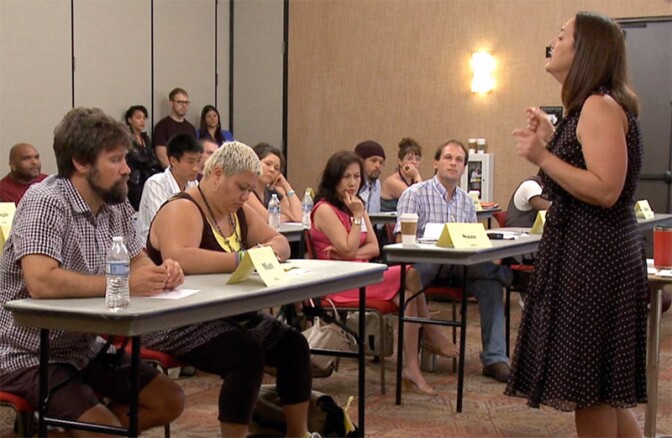
My students were on their own. If they were going to go to college, nosotros could assist pay for the books for the semester. The volume was eventually translated in over a dozen languages, and information technology became number one on the New York Times All-time Seller List. Then we started training teachers and giving scholarships to educators. Now we have 700 Liberty Writer teachers. They're in every single state in America, 8 provinces in Canada and 20 countries.
Information technology's incredible because these Freedom Writer teachers are doing the exact same affair that I did with my students. They're doing information technology better because they're not alone. I was lonely, and I was making stuff up equally I went. We deal with everything that a instructor would face with kids including mental health, suicide, habit, violence and learning disabilities.
What are some of the biggest challenges you run into public schools facing today?
Gruwell: We recently started a podcast and nosotros had Father Greg Boyle who started Homeboy Industries and Dr. Pedro Noguera from UCLA whose enquiry is about the schoolhouse-to-prison pipeline. What I have found, and what Father Boyle and Patrick take also institute, is the implicit bias and the segregation that is still happening in our schools and how that leads to the school-to-prison pipeline. I spend the vast majority of my fourth dimension visiting juvenile halls, and it is unduly young men of color. Whatever we're doing in our schools isn't enough to engage our young voices.
For me, education is very politicized. We send our kids away to discipline them and nosotros haven't learned to teach Socratically to make them a office of the process. It's very liberating when you requite somebody a voice. And and then I think that our book was the voice. I think that our feature film was the vocalisation. I recall this documentary is the most exquisite of all three because y'all see and hear them in their natural habitat. In the books, they were anonymous and they were numbered. The feature pic was a extravaganza. The documentary is down and dirty.
dickinsoncomel1957.blogspot.com
Source: https://www.pbssocal.org/shows/freedom-writers-stories-heart/how-california-teacher-erin-gruwell-inspired-a-generation-of-writers
0 Response to "Black Kids Read the Diary of Anne Frank"
Postar um comentário